 EN_US
EN_US  İspanyolca
  Русский
  العربية
  Portekizli Brezilya
  Fransızca
  Bahasa Indonesia
  Türkçe
  Tiếng Việt
  Bahasa Melayu
  Українська


 Teknik Bilgi
Teknik Bilgi
Bridge Launching Gantry Capacity: Precast Girder Weight & Key Parameters
Soyut
At bridge construction sites, selecting a köprü fırlatma vinci is critical in project preparation. Facing tight schedules and complex environments, many engineers treat precast beam weight as the only standard. For a 200-ton beam, they directly match a 200-ton lifting device. This simple match often hides unexpected risks during launching and erection.
Precast beam weight is a basis for lifting capacity, but never the only one. Underestimated capacity may cause overload, slow operation, or serious safety risks. Conversely, blind overcapacity raises procurement and ocean freight costs. It also makes narrow on-site assembly harder. Scientific selection is a rigorous systems task. It must match rated capacity, spreader self-weight, erection span, dynamic conditions, slopes, and curves. Therefore, selection must go beyond simple tonnage matching. It integrates engineering mechanics, site geography, standards, and life-cycle costs. This article covers beam weight calculation, key parameters, common mistakes, international standards (ISO/FEM/EN), and overseas cases. It reviews the full process of bridge launching gantry selection and parameter verification. This helps teams avoid design and procurement traps. It balances equipment performance, safety, and economic benefits.
Ready to optimize equipment selection for your next bridge project?
We have prepared a complete “Bridge Launching Gantry Parameter Verification and Selection Guide White Paper” for engineering and procurement teams. It includes detailed load calculation logic and on-site verification checklists. For professional selection advice or further technical support, please contact the HSBRIDGE technical team.
[İletişime geçin HSBRIDGE Technical Team]

How Does a Bridge Launching Gantry Lifting Capacity Match Precast Beam Weight?
In actual project construction, bridge launching gantry lifting capacity must never be applied blindly. Rough estimates or empiricism must not guide its use. Many on-site problems stem from misunderstanding “weight” and “rated capacity.” To truly achieve precise matching, we must examine four dimensions layer by layer:
Clarify the Actual Weight of the Precast Beam
The theoretical weight on design drawings does not fully equal actual lifting weight.
- Beam type differences: Wide box girders, traditional T-beams, I-beams, and segmental beams differ greatly. Their geometry and center-of-gravity distribution are completely different. For example, box girders are heavy and have variable bottom slab thickness. Some projects also involve wet joints or temporary loads before secondary casting.
- Lifting method: Verify whether single-machine independent operation or dual-machine tandem lifting is required. In dual-machine tandem lifting, load distribution ratios often are not equal. They directly determine actual forces on each machine or lifting point.

Verify Equipment Rated Lifting Capacity
Never treat the number on the equipment nameplate as a universal pass.
- Working condition consistency: Rated lifting capacity changes with radius, span, and cantilever state. Lifting capacity at maximum span usually decreases.
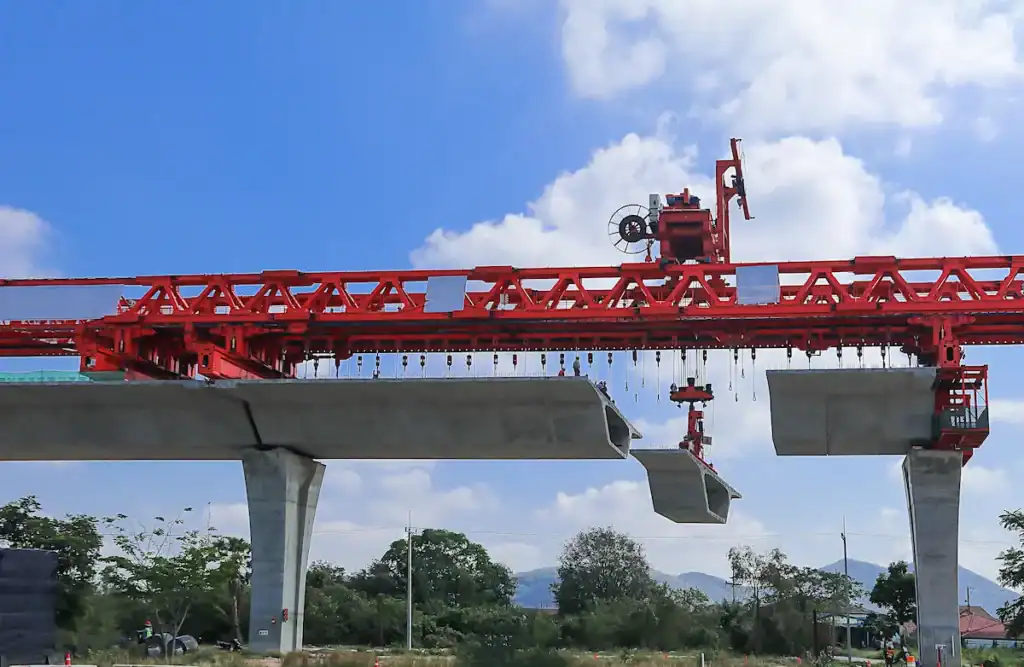
- Whole machine versus single trolley: Clarify whether the nameplate marks total machine capacity or single hoist trolley capacity. For example, a bridge launching gantry rated 200 tons may use two 100-ton trolleys. If single-point concentrated force exceeds limits, local structure may suffer fatal damage. This can happen even when total weight is not exceeded.
Include Spreader and Other Loads in Calculation
This is the easiest on-site account to miss: spreader weight is not beam weight. But the bridge launching gantry must carry the spreader weight.
- Accessory accumulation: Dedicated lifting beams, equalizing beams, wire rope rigging, shackles, and hooks often total several tons. They may even total over ten tons.
- Calculation basis: When checking technical agreements with manufacturers, confirm whether rated capacity already deducts spreader self-weight. Also confirm whether extra margin is required. If spreaders are not included in load combination, actual lifting equals hidden overloading.
Consider Dynamic Effects During Lifting
Static weighing and dynamic lifting are completely different matters.
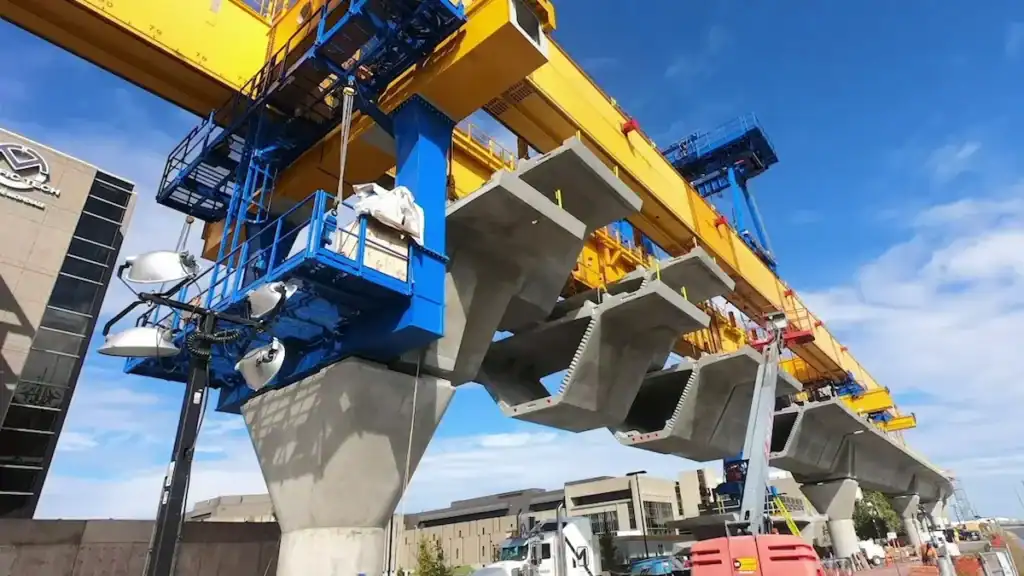
- Dynamic load factor: Beam lifting, braking, longitudinal travel, and lateral movement generate inertia forces and impact loads. Equipment design introduces corresponding dynamic load factors.
- Avoid blind over-specification: Some teams add extra safety factors beyond manufacturer design parameters to seek stability. This practice raises procurement costs and may make the whole machine too heavy. It may also block launching. The correct approach is reviewing formal engineering verification documents from the manufacturer.
Besides Beam Weight, What Other Key Parameters Need Verification?
A köprü fırlatma vinci is a steel giant. Beam weight is only the first step. Eight key parameters are indispensable.
| Parameter Dimension | Key Verification Content | Actual Impact on Selection and Construction |
| Erection Span and Main Girder Structure | Max standard/non-standard span, stiffness, deflection | Determines bending, anti-overturning during launching, load limit. |
| Precast Beam Dimensions and Lifting Points | Length, width, height, center of gravity, lifting point spacing | Affects spreader design, trolley travel, dual-trolley coordination. |
| Lifting Height and Beam Placement Accuracy | Max lifting height, hook travel, micro-speed control | Determines high-pier/deep-valley clearance and alignment accuracy. |
| Longitudinal Slope, Cross Slope, and Curves | Max longitudinal slope (≤4%), cross slope, minimum curve radius | Affects braking, anti-slip, and lateral stability during launching. |
| Outrigger Reaction and Deck Bearing | Max outrigger reaction, wheel pressure, deck/cap beam capacity | Prevents deck cracking or local collapse. |
| Anti-Overturning and Wind Load | Working/non-working wind grade, anti-overturning safety factor | Sets safety bottom line in windy coastal/high-altitude areas. |
| Lifting and Control System | VFD, dual-trolley synchronization, PLC, load monitoring | Controls impact, sway, and mechanical wear during lifting. |
| Construction Sequence and Transport | Launching method, beam feeding direction, dimensions, transfer weight | Ensures on-site assembly and road limit compliance. |
In selection, these parameters intertwine with beam weight. Any missed item may cause delays or safety hazards.
Common Misconceptions in Bridge Launching Gantry Selection
On-site selection seems simple, but habitual thinking misleads it. We summarized six common pitfalls.
On-site selection seems simple, but habitual thinking misleads it. We summarized six common pitfalls.
① Only by Beam Weight, Ignoring Spreader Loads
People take net beam weight, such as 180 tons, and seek 180-ton equipment. But lifting beams, slings, saddles, and hooks add several to ten-plus tons. Ignoring spreader weight or unverified rated capacity can cause dangerous overload.
② Assume Larger Capacity Is Always Better
Larger capacity means bigger main girders, heavier total weight, and larger dimensions. It may get stuck passing tunnels, overpasses, or narrow sections. Extra weight also pressures assembly yards and site bearing capacity.
③ Only Check Normal Erection, Not Launching
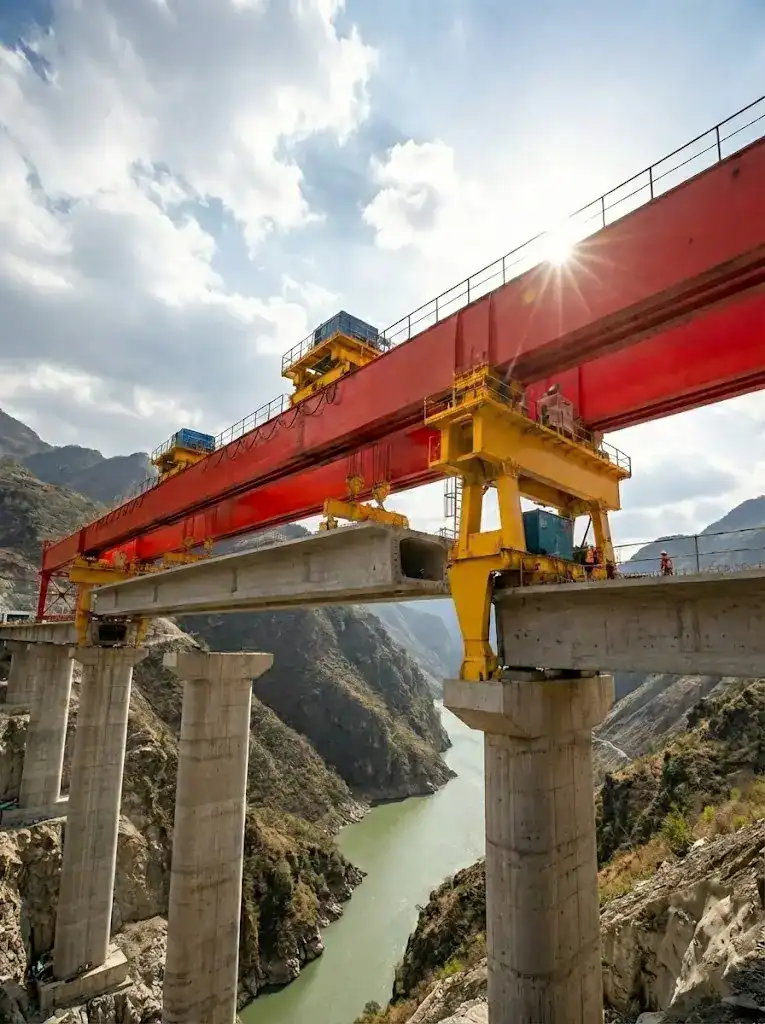
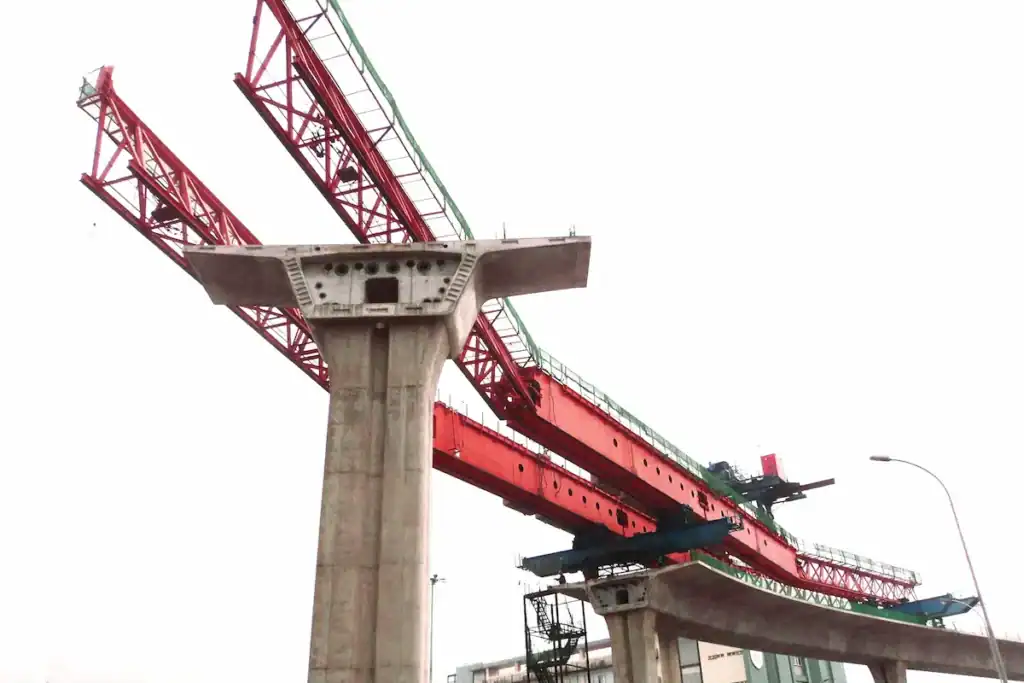
A gantry must lift beams and travel. Teams often assess stable mid-span lifting only. They ignore launching to the next pier, when the gantry is cantilevered. Then main girder stability, anti-overturning, and rear outrigger anchorage are most critical.
④ Ignore Outrigger Reactions and Deck Bearing
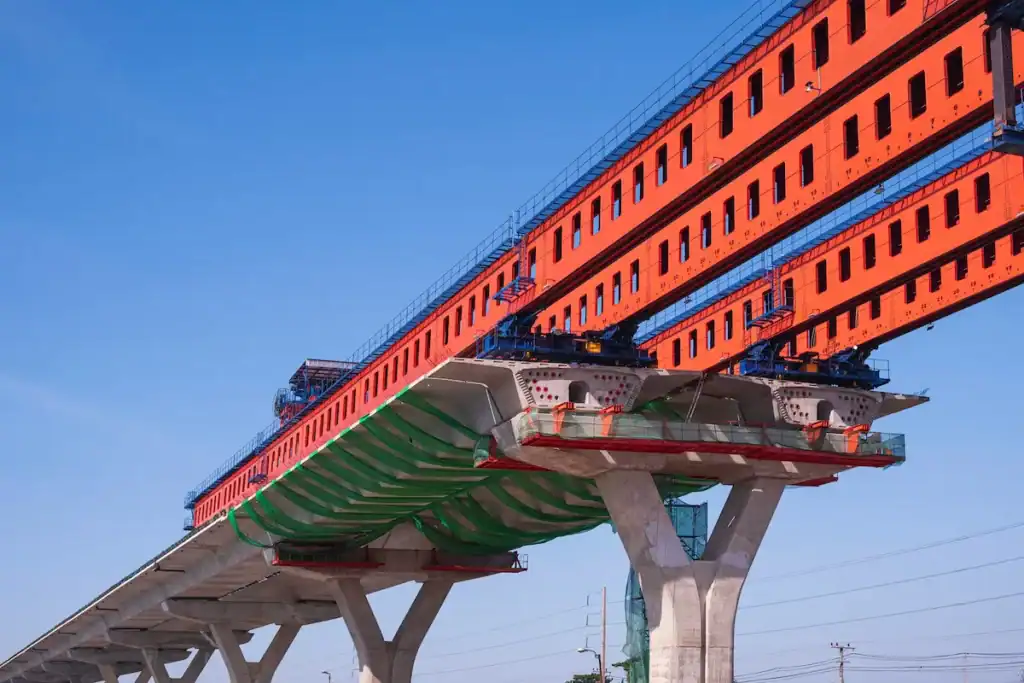
Outriggers landing on completed decks create huge concentrated reactions. Without checking local limits of deck slabs, cap beams, or pavement, collapse or cracks may occur.
⑤ Copy Other Project Parameters Without Verification
Beam length may match, but slopes, curves, and pier heights may differ. Direct reuse without comparison often causes outriggers that cannot level or trolleys that cannot shift.
⑥ Compare Only Price, Ignoring Total Costs
Oversized components multiply ocean freight and transport permits. Without modular design, assembly and commissioning may take extra weeks. Delay costs often exceed the equipment price difference.
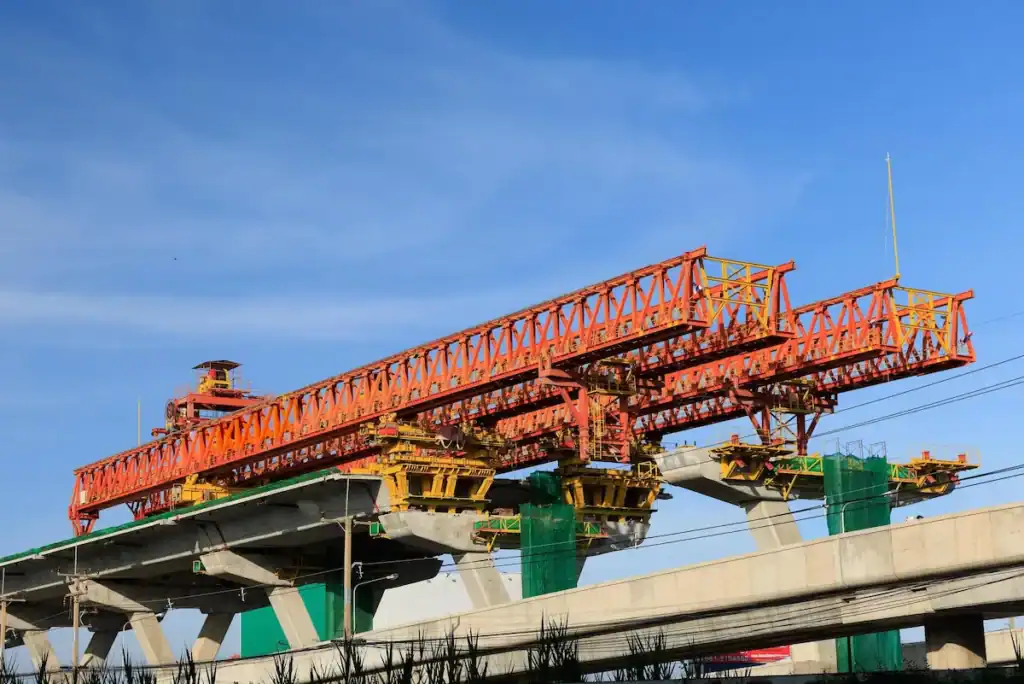
Product Advantages of HSBRIDGE Köprü Fırlatma Vinçi
Actual selection faces structural redundancy, transport difficulty, and complex condition adaptation. HSBRIDGE bridge launching gantry fully incorporates strict international codes. It does so in structural design and safety control.
- Precise Custom Design Based on Beam Weight and Span: It strictly follows ISO 4301-1:2016 classification and FEM 1.001 Book 3 main girder stress and fatigue verification. Based on actual beam weight and maximum span, finite element analysis (FEA) optimizes the main girder section. This achieves optimal matching between bearing capacity and self-weight.
- Efficient Adaptation to Multiple Bridge Structures and Complex Conditions: It complies with EN 15011:2020 Clause 5.2.1. The equipment flexibly handles box girders, T-beams, I-beams, skew bridges, and small-radius curved beams. It smoothly adapts to longitudinal slopes of 4% to 6% and cross slopes above 3%. This ensures safe beam placement for mountain and urban viaducts.
- Modular Structural Design and Efficient On-Site Installation: Manufacturing follows EN 1090-2:2018 EXC3 standards. High-strength bolts and pins connect components. Split units fit perfectly into 40ft HQ containers or standard flatbed trucks. On-site assembly is fast without complex welding.
- Intelligent Operation Control and Multiple Safety Guarantees: It complies with EN 13000:2010+A1:2014 Clause 4.2 limiter specifications. It features full variable frequency drive (VFD) and millimeter-level dual trolley synchronization. Wind speed monitoring and outrigger reaction sensors are integrated. It automatically warns and cuts off under eccentric or overload conditions.
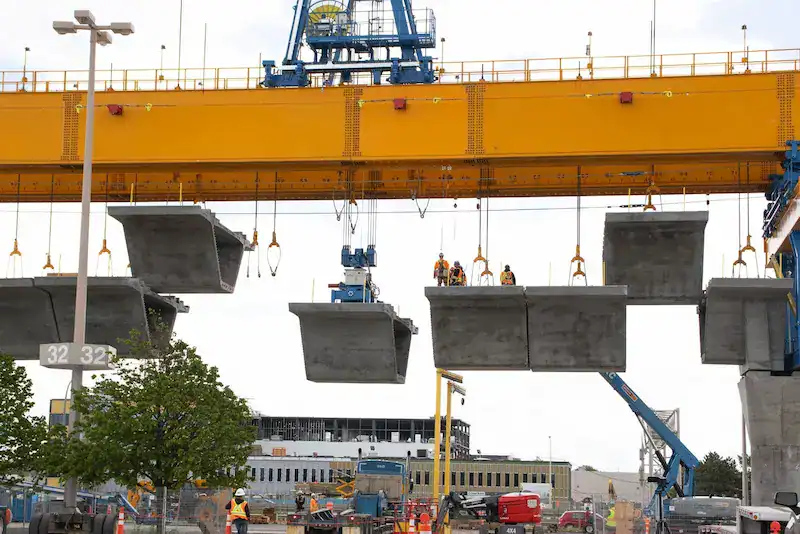
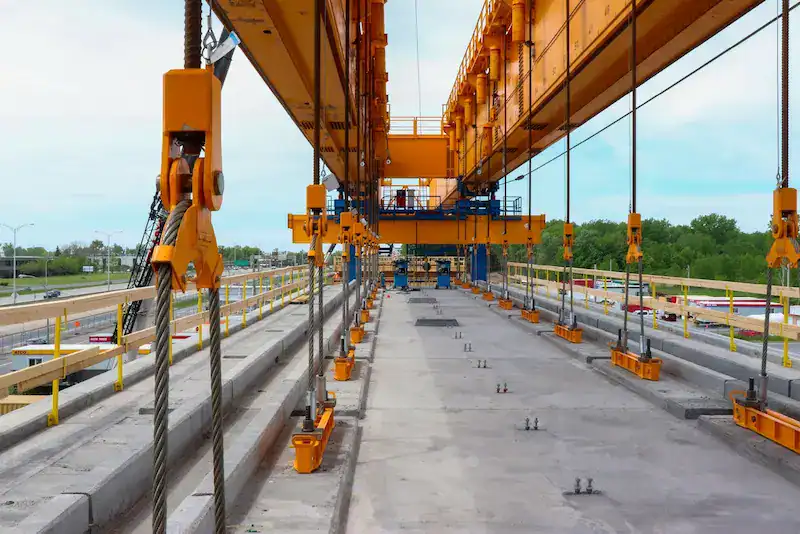
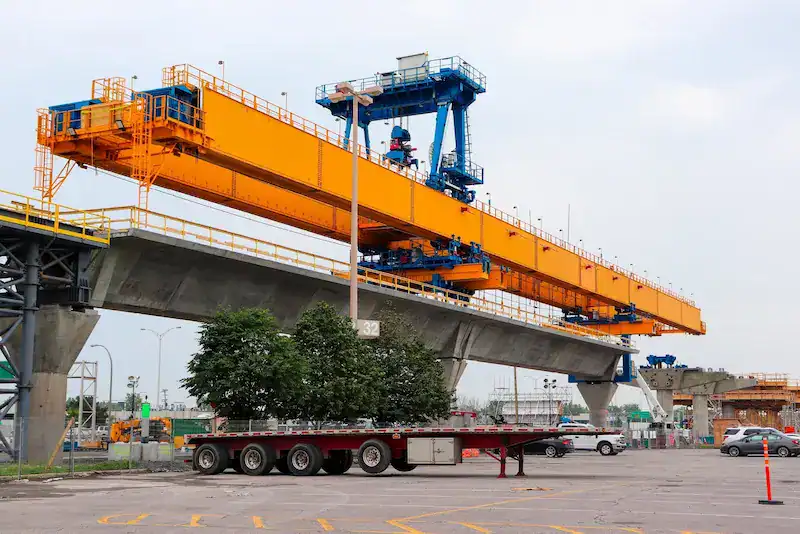
HSBRIDGE Classic Cases: Matching Equipment to Actual Beam Weight and Erection Conditions
In overseas heavy infrastructure construction, a tiny parameter mismatch causes huge on-site errors. The following two typical overseas highway bridge projects deeply involve HSBRIDGE. They perfectly illustrate the selection logic: “Beam weight is only the starting point; complex conditions determine success.”
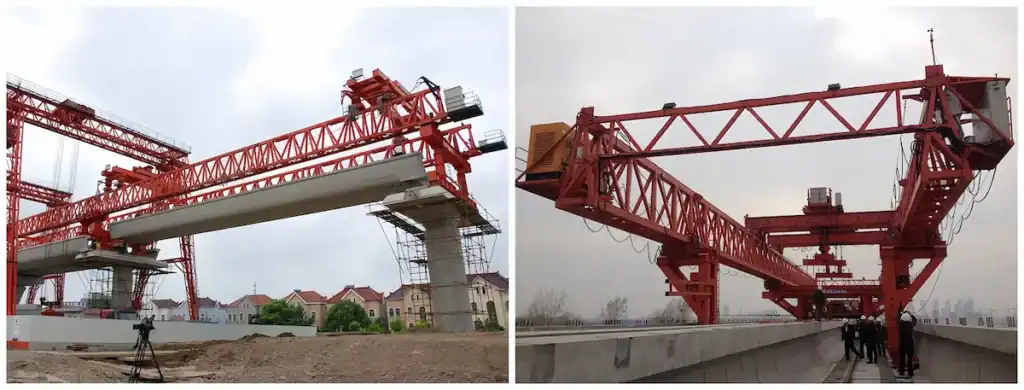
Pakistan Project: 220-Ton Bridge Launching Gantry for 50-Meter Erection Span
- Client and Project Background: The client is the core general contractor for the local National Highway Authority (NHA). The project route crosses complex mountainous and river valley areas. Terrain relief is large, and geological conditions are harsh.
- Core Equipment Configuration: The core equipment is a HSBRIDGE 220-ton double-guide-beam bridge launching gantry. It adapts to a maximum erection span of 50 meters. Multiple sets were delivered.
- Working Condition Parameters and Challenges: On-site longitudinal slope reaches 4%, and cross slope is 3%. The minimum erection curve radius is only 600 meters. This demands extremely high main girder bending and torsional performance. It also severely tests braking, anti-slip, and launching stability on long steep slopes.
- Structural and Control Features: It uses a symmetric double-guide-beam structure. It is equipped with a full variable frequency drive control system. This smoothly handles dynamic inertia during heavy beam erection and long-distance launching.
- Installation and Testing: Before delivery, the bridge launching gantry completed full assembly and dynamic/static load tests in the factory. A 1.1-times overload test was conducted according to international codes. All structural deformation and stress indicators fully met standards.
- Selection Insight: Equipment rated lifting capacity alone cannot determine applicability. Span, longitudinal/transverse slopes, curve radius, and launching stability must also be included. They require comprehensive selection evaluation.
Indonesia Project: 200-Ton Bridge Launching Gantry for Precast Box Girder Erection
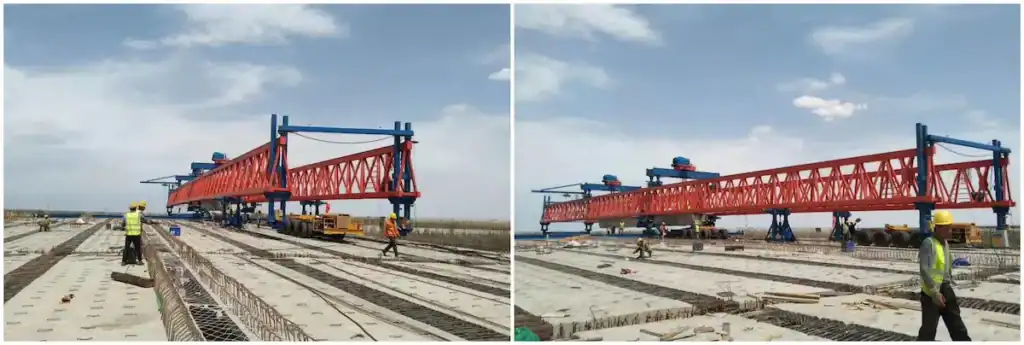
- Client and Project Background: The owner is an Indonesian national expressway project consortium. The schedule is extremely tight. The main task is dense erection of many 30-meter and 40-meter standard prestressed concrete box girders.
- Core Equipment Configuration: The core equipment is a HSBRIDGE 200-ton box girder bridge launching gantry. Rated lifting capacity is 200 tons. Applicable span is 30 to 40 meters, and rated lifting height is 12 meters.
- Technical Features and Highlights: For fast-paced dense box girder erection and high alignment requirements, it includes dual hoist trolley synchronization. It also includes a programmable control system (PLC) and highly sensitive load monitoring. The project team stays on site throughout. It provides equipment assembly, commissioning, and operator training based on site needs.
- Selection Insight: Beam type, span, lifting height, and construction pace must be verified together. Standardized, high-frequency box girder erection depends more on control synchronization accuracy. It also depends on after-sales support response speed.
Pre-Purchase Parameter Checklist for Bridge Launching Gantry
| HAYIR. | Parametre | Key Check Items and Quantitative Indicators | Actual Impact on Selection and Site Construction |
| 1 | Precast Beam Weight and Center of Gravity | Max single beam weight, eccentric load factor, center-of-gravity position | Determines rated capacity baseline and anti-overturning margin. |
| 2 | Spreader and Accessory Loads | Dedicated lifting beam, spreader, wire rope rigging, hook self-weight | Must be included in total lifting load to prevent hidden overload. |
| 3 | Rated Capacity and Working Conditions | Rated capacity, mid-span capacity, cantilever and launching capacity | Confirm nameplate parameters match worst actual conditions. |
| 4 | Span and Main Girder Structure | Max standard span, non-standard span, deflection, bending stiffness | Determines spanning ability, deformation control, and launching stability. |
| 5 | Beam Dimensions and Lifting | Beam length, width, height, lifting point spacing, max lifting height, hook travel | Ensures trolley travel, lifting point fit, and clearance for high piers. |
| 6 | Terrain and Geometric Conditions | Max longitudinal slope (e.g. ≤4%), cross slope, minimum curve radius, skew angle | Affects launching braking, anti-slip performance, and skew beam alignment. |
| 7 | Outriggers and Bridge Deck Bearing | Max outrigger reaction, wheel pressure distribution, completed deck/cap beam capacity | Avoids cracking deck slabs, box girder top slabs, or cap beams. |
| 8 | Safety and Wind Load Conditions | Working/non-working wind resistance, wind anchorage, load and limit devices | Sets safety and anti-overturning bottom line in windy areas. |
| 9 | Construction Sequence and Launching | Launching method (single/dual guide beam), beam feeding direction, travel sequence | Determines site organization efficiency and force transfer rationality. |
| 10 | Transport and Delivery Support | Max single transport size (40ft container), assembly space, delivery cycle | Affects ocean freight, land transport permits, and assembly time. |
Çözüm
In the grand narrative of bridge engineering, a bridge launching gantry is never an ordinary commodity. It cannot be casually matched by model or tonnage. It directly concerns project success, schedule, and construction safety. As analyzed earlier, precast beam weight is only the starting point for equipment selection. It is never the only basis. This includes spreader self-weight accumulation and dynamic load factor correction. And includes ultimate anti-overturning under cantilever launching. It includes matching outrigger reactions with bridge deck bearing capacity. It also includes complex geometry such as longitudinal/transverse slopes and small-radius curves. Every tiny parameter deviation may amplify on site. It may become an uncontrollable safety hazard or high rectification cost.
Scientific equipment selection is essentially a systems engineering task. It deeply integrates engineering mechanics, site geography, international manufacturing standards (ISO/FEM/EN), and life-cycle costs. Choosing an excellent bridge launching gantry means choosing more than powerful lifting capacity. It means choosing rigorously verified safety assurance and efficient output.
Not sure which bridge launching gantry matches existing beam weight and bridge span?
Please provide beam weight, beam type, span, lifting height, and site slope. Contact the HSBRIDGE technical team for selection advice for your project conditions.
[Click Here to Contact the HSBRIDGE Professional Team]
Further Reading Recommendations
Finalizing equipment selection is only the first step in overseas heavy bridge construction. For overall project execution, read the companion article:
《Köprü Kirişi Fırlatma Projesi Planlaması: Mühendisler İçin Nihai Kılavuz》
It covers customs clearance, assembly, commissioning, scheduling, and multi-outrigger transfer, helping you complete the “last mile.”
SSS
Q1: Why is “looking only at precast beam net weight” costly in bridge launching gantry selection?
A: Drawing tonnage is concrete and rebar net weight, excluding accessories. Lifting beams, spreader frames, rigging, ropes, and hooks often weigh several to ten-plus tons. If beam weight matches rated capacity, hidden overload occurs at lift-off, risking fatigue or accidents.
Q2: Can a conventional bridge launching gantry be reused for non-standard spans or special beam types?
A: Difficult. Length or tonnage may match, but slopes, curves, and deck bearing differ. Small curves challenge anti-overturning and trolley travel. Large slopes increase anti-slip resistance. Blind reuse may cause unlevel outriggers or failed launching.
Q3: What is the difference between launching and normal beam erection?
A: Normal erection: stable outrigger support, vertical loads on piers/decks. During launching, the bridge launching gantry is cantilevered with forward center of gravity. Main girder bending, rear outrigger anchorage, and anti-overturning face worst test. Verify launching-stage calculations.
Q4: Why do overseas projects emphasize ISO, FEM, and EN standards?
A: Overseas contracts face strict audits and third-party inspections. Equipment designed to ISO 4301-1, FEM 1.001, EN 15011, and EN 13000 has international credibility for fatigue, load limitation, and electrical safety. It also shortens customs, inspection, and acceptance.
Q5: How to balance lifting margin with procurement and logistics costs?
A: “Buy larger, not smaller” is a misconception. Excessive tonnage means thicker girders, heavier weight, higher cost, and more ocean freight. It also burdens narrow yards and deck capacity. Use FEA with the manufacturer. Customize for worst conditions. Balance safety, self-weight, and economics.
Bu belge yalnızca referans amaçlıdır. Belirli işlemler, yerel yasa ve yönetmeliklere ve ekipman kılavuzlarına kesinlikle uygun olmalıdır.

Köprü Projeniz İçin Uzman Tavsiyesi Alın
Mühendislik ekibimiz köprü inşaat ekipmanları konusunda onlarca yıllık deneyime sahiptir. Doğru çözümü bulmanıza yardımcı olalım.

 Sohbet etmek için tarayın