 EN_US
EN_US  Español
  Русский
  العربية
  Português do Brasil
  Français
  Bahasa Indonesia
  Türkçe
  Tiếng Việt
  Bahasa Melayu
  Українська

 Installation
Installation
Mastering Site Mobilization: How Pin-Connection Design Speeds Up Launching Gantry Assembly
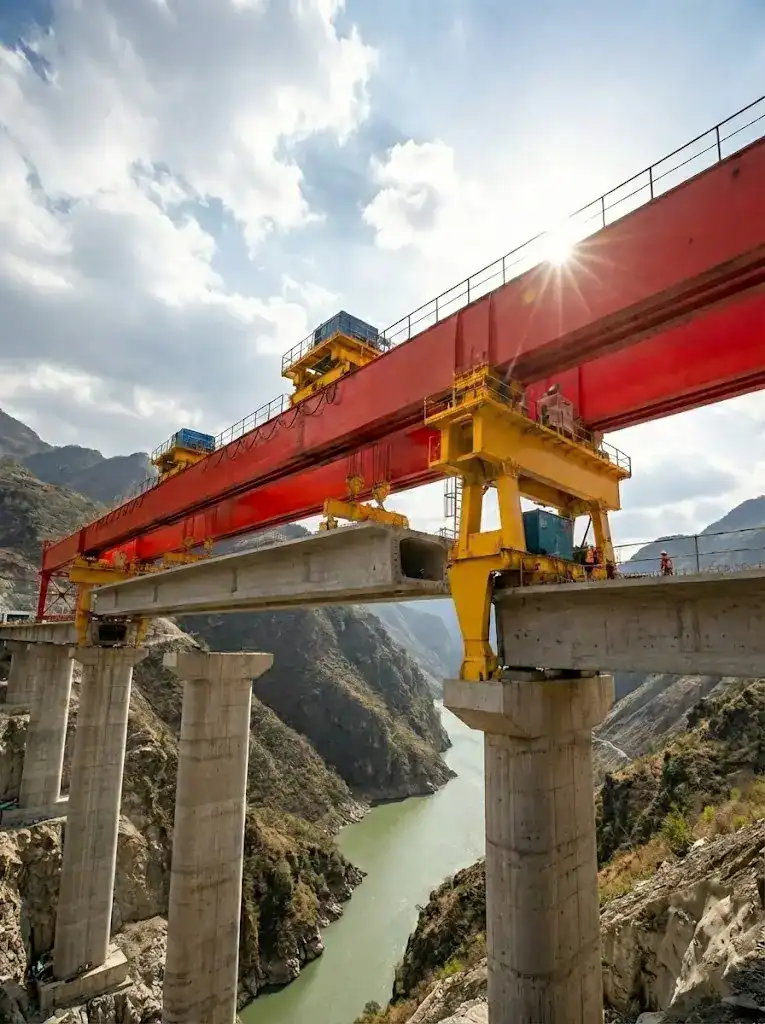
For EPC contractors and project managers handling large-scale bridge construction, Site Mobilization is often one of the most unpredictable cost centers. Moving a massive 450t or 900t Launching Gantry to a remote site is only half the battle; assembling it quickly and safely is where project schedules are either saved or ruined.
Traditionally, assembling heavy bridge erection equipment relied heavily on extensive on-site welding. However, modern engineering has shifted toward a far more efficient solution: The Modular Pin-Connection Design.
In this technical insight, we explore why replacing welding with high-tensile pin connections is revolutionizing site mobilization, slashing assembly times, and maximizing ROI for global contractors.
The Bottleneck of Traditional On-Site Welding
To understand the brilliance of pin connections, we must first look at the hidden costs of traditional welded gantry structures on a job site:
- Reliance on Highly Skilled Labor: Precision welding requires certified, high-tier welders. Finding them in remote mountainous regions or overseas project sites is both difficult and expensive.
- Weather Dependency: Quality welding cannot be performed in high humidity, heavy rain, or strong winds. A single week of bad weather can stall your entire erection schedule.
- Mandatory NDT (Non-Destructive Testing): Every critical welded joint must undergo ultrasonic or X-ray testing to ensure structural integrity. This adds days to the commissioning phase.
- Permanent Commitment: Once welded, disassembling the gantry for transfer to the next bridge project requires cutting, which damages the structure and guarantees a grueling demobilization process.
The Engineering Behind Pin-Connection Technology
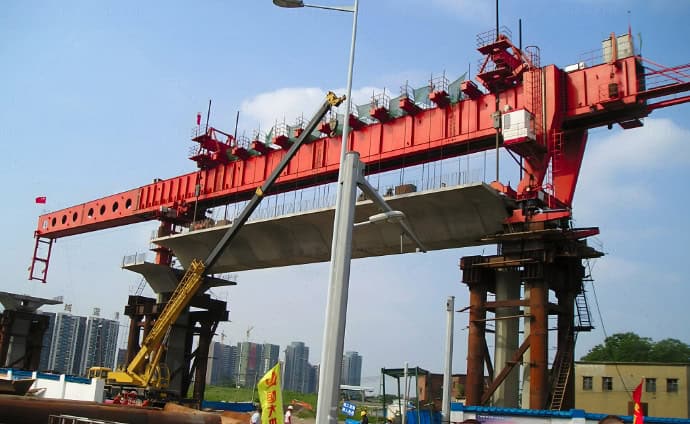
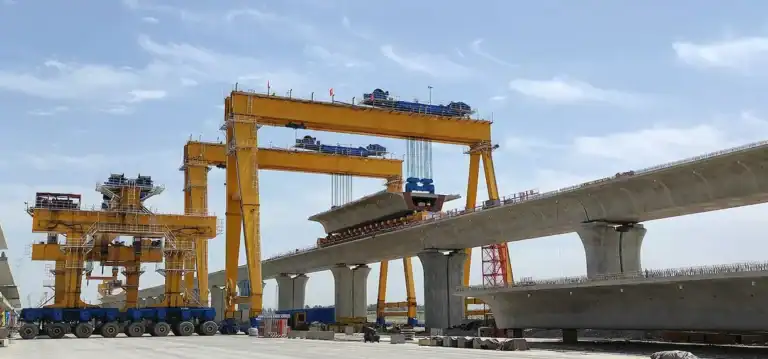
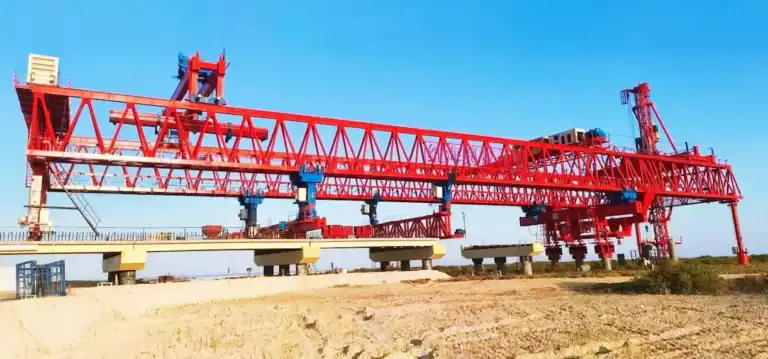
Our Launching Gantries utilize a Modular Honeycomb / Truss Structure where up to 90% of the main structural joints are connected using high-tensile steel pins rather than welds.
During the manufacturing process in our facility, the main girders are fabricated in standardized modular sections. The pinholes are precision-bored using advanced CNC machinery to ensure zero-tolerance alignment.
When these modules arrive at your construction site, assembling them is essentially a large-scale, high-precision interlocking puzzle.
3 Major Advantages for Contractors
1. Drastically Reduced Assembly Time (Ready in 7-15 Days)
Time is money. By eliminating the need for complex welding, grinding, and subsequent NDT testing, the assembly timeline is slashed by more than 60%. A standard highway beam launcher can be fully assembled, commissioned, and ready for its first lift within 7 to 15 days of arriving on site. Workers simply align the modules using mobile cranes and drive the hydraulic pins into place.
2. Weather Independence & Lower Labor Costs
Pinning a truss together is a mechanical process that is highly resistant to weather delays. You can assemble the gantry in the rain, wind, or extreme heat. Furthermore, it completely removes the need for an army of certified welders. Your standard rigging crew, equipped with basic hydraulic tools and sledgehammers, can handle the structural assembly safely and efficiently.
3. Seamless Relocation (High Reusability ROI)
Bridge projects are linear. Once Viaduct A is finished, the machine needs to move to Viaduct B. The pin-connection system allows the launching gantry to be disassembled just as quickly as it was built. You simply extract the pins, load the standard modules onto flatbed trailers, and move them down the highway. This protects the steel structure from the fatigue and damage associated with cutting and re-welding, significantly extending the lifespan of your investment.
Safety First: Maximizing Ground-Level Pre-assembly
Safety is the ultimate priority in bridge construction. The modular nature of the pin-connection system enables our Ground-Level Pre-assembly strategy.
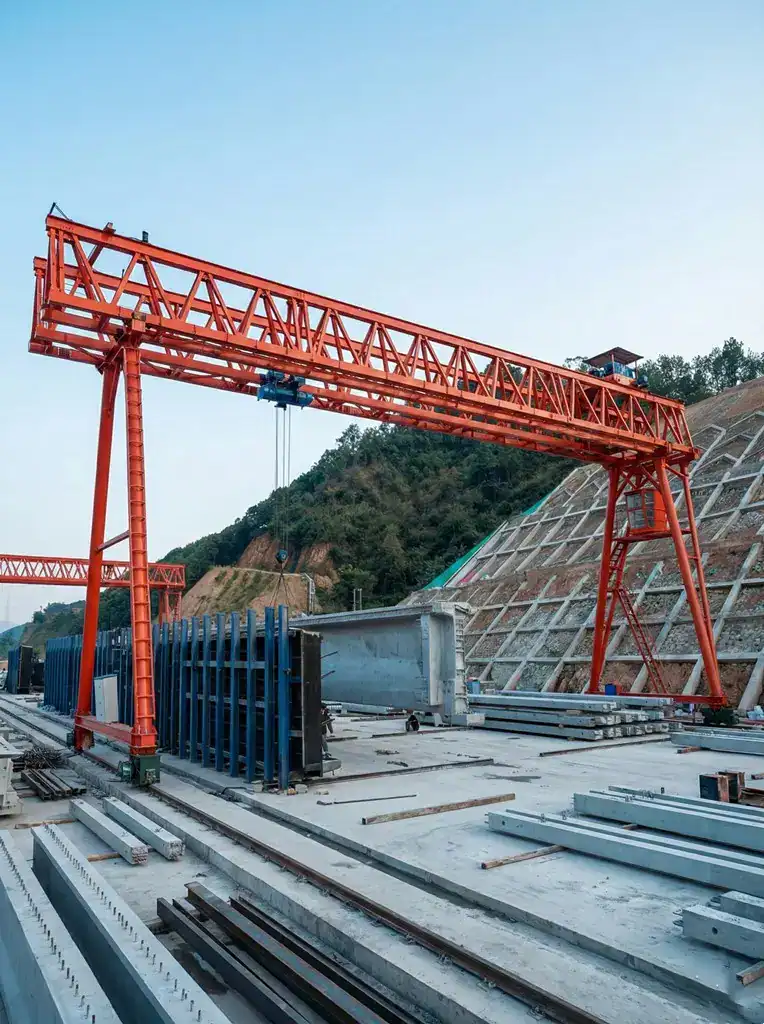
Instead of workers balancing on 50-meter-high concrete piers trying to align and weld massive steel plates, large sections of the main truss are pinned together on the solid ground of the precast yard or bridge abutment. Once a large continuous segment is secured, it is hoisted onto the piers by heavy mobile cranes. This minimizes high-altitude work and drastically reduces the risk of fatal accidents.
When selecting a Bridge Girder Erection Machine, contractors must look beyond just the lifting capacity. The true cost of the equipment includes the time and resources required to mobilize, assemble, and relocate it.
By investing in a Pin-Connected Modular Launching Gantry, you are not just buying a lifting machine; you are buying predictability, safety, and a guaranteed acceleration of your project schedule.
Ready to see how our equipment goes together? Our engineering team provides comprehensive assembly supervision and detailed General Arrangement (GA) drawings for every project.

Get Expert Advice for Your Bridge Project
Our engineering team brings decades of experience in bridge construction equipment. Let us help you find the right solution.
 Scan to chat